High density compression molded coils

|
* By compression molding, the coil is packed to fill the core space. achieve a fill factor of 89-93% without damaging the coating of round wire! Filling the core space completely through compression and molding |
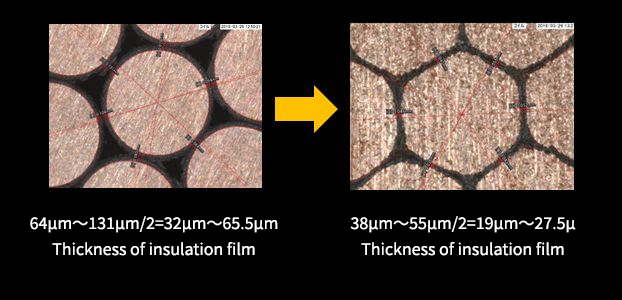
Thickness of insulation film
|
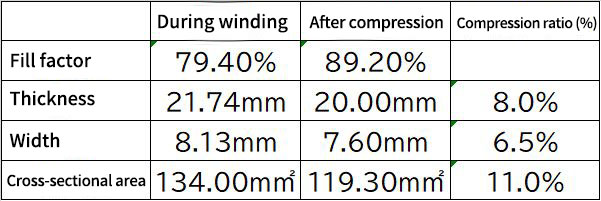
Data comparison before and after compression and molding |
|
(Coil using self-fused wire with diameter of 0.9 mm) |

|
Layer short circuit testing after compression 800V 1500V |
|
10-pulse application OK |
|
Measurements taken using 3D measuring instrument, digital calipers, |
|
Characteristic DCR meter, LCR meter, layer short-circuit tester (impulse application test) |
|
Evaluated with withstand voltage tester |

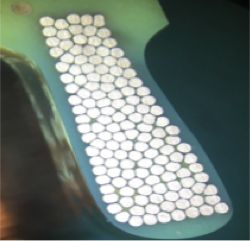
Cross-sectional image after compression

|
Image of the coil attached to the core |
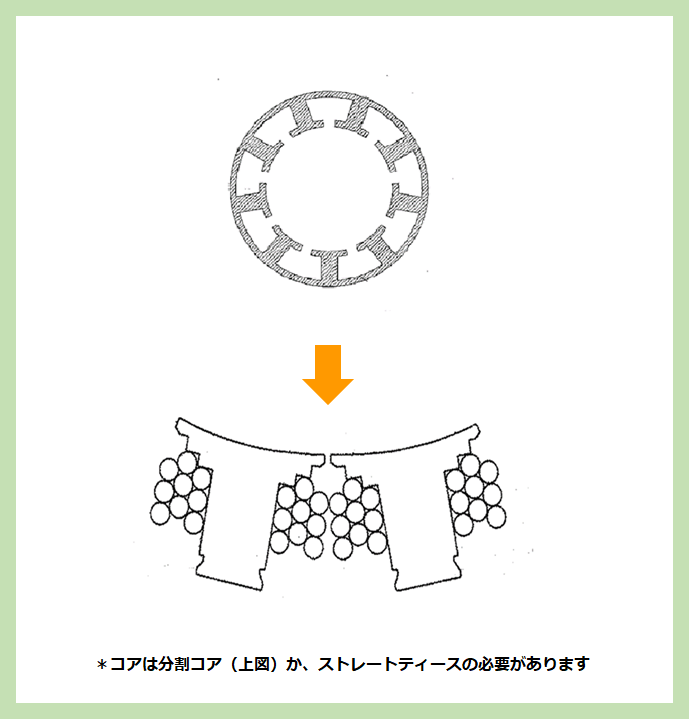
Teeth shape
|
* The core needs to be a split core (upper diagram), or have strait teeth. |
|
Explanation: |
|
Coil is tightly wound in steps, then compressed and molded → 79-82% → 89-93% |
|
(1) The process involves compressing and molding simultaneously with an air core coil wound to high density. |
|
(2) Compressing the coil reduces the gaps between the coil wires. |
|
(When protecting the coating is a priority, weakening the compression retains more thickness in the coating) |
|
(3) Molding the coil flattens out the bumps in the stepped surface of the coil. |
|
(4) The coil is inserted into straight teeth or a split core, but some kind of insulation is needed between the ground plane and the inner diameter of the coil and adjacent coil. |
|
As a result, if the gap in the insulation between the inside of the coil or the core teeth is eliminated, gaps will be almost completely eliminated, increasing the fill factor beyond a flat wire stepped winding coil. |