Are you ready to challenge conventional thinking?
An urgent message to those involved with coil development!
Coil technologies in the era of electric vehicles: You want to increase the fill factor
of coil technologies as much as possible
And you also want to keep costs down
The new concept of compressing and shaping round wire instead of flat wire to fill the
teeth section of a motor core will greatly advance motor technologies in the future.
Preconception 1:Coils should not be bent or crushed.
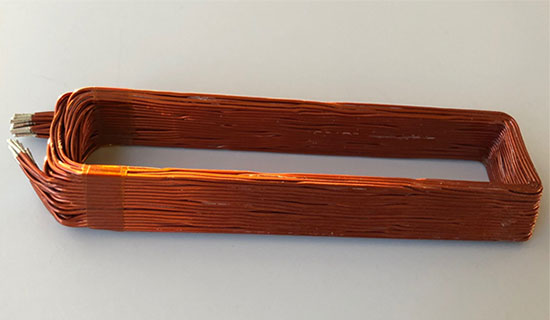
Coils are pliable.
Until now, pressing or crushing wound coils has been considered a long-standing industry
taboo.
But Selco has developed industry-first coil processing techniques to bend, compress and
shape coils, breaking the taboo.
"Will the coating be okay?"
"Of course!"
As a result of high-density winding technologies superior to its competitors and a
process of trial and error on new techniques, Selco has established a revolutionary new
technique in the coil industry, enabling coils to be bent, compressed and shaped with
almost no affect on the coating.
Preconception 2:Are coils for contactless charging safe under various conditions?

Selco has a long-established reputation producing the coils used in IH rice cookers, IH
kettles and similar products.
For more than two decades we have been working on coils using litz wires, and have
accumulated extensive expertise in the field.
The winding wire in coils for contactless charging are nearly the same. Various
manufacturers have different requirements, and through the process of meeting them, we
have accumulated a wide range of technologies.
In particular, we have been among the first in the industry to establish technologies
for durability in terms of impact and water resistance, as well as flexibility.
Preconception 3:The inner diameter of an air core coil must be at least 0.15 mm.
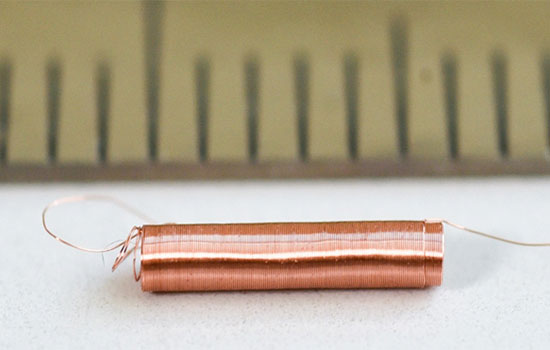
This preconception was also the conventional thinking at Selco for many years.
But just as records are meant to be rewritten, conventional thinking on coils has been
rewritten by our technical team.
We recently fielded a request from a customer for an inner diameter of 0.11 mm and
successfully developed an air core coil meeting this specification.
If we were asked to develop one with an inner diameter of 0.09 mm, we think it is
probably possible.
Customer needs truly are the mother of invention.
Preconception 4:There is no coil that Selco cannot deliver.

This is a lie.
In the end, no matter how much technology we have, there are some coils that are
absolutely impossible.
But the customers that submit requests shouldn't give up easily, but persevere.
Our engineers are only human.
They may say something is troublesome or difficult and reject it at first, but don't let
them off easily.
Because our engineers will tend to come around if you persist.
Preconception 5:A coil is wound from the inside to the outside ⇒ an alpha winding coil can only be double-layered.

So-called "outer / outer winding" is achieved with an alpha winding coil, but this is
double-layered.
Selco's technical team has successfully developed a multi-layered alpha winding
coil.
With this technology, the conventional wisdom that winding terminals go from inside to
outside has been broken. The technical staff at manufacturers can make designs without
worrying about the winding start terminal during development, and we think this will
become a revolutionary technology going forward.
Preconception 6:The skills of craftspeople cannot be easily mechanized.
Admittedly, it is difficult.
At Selco, there was once a coil processing task that could only be performed by a
specific worker.
He was a Brazilian worker.
He always held the trump card of threatening he would "quit and go back to Brazil!"
Since the site supervisor thought there would be trouble if he quit, he had to listen to
all his selfish demands, and had to avoid giving him overtime as much as possible.
But in fine style, our talented employees managed to automate the task.
It wasn't fully automated, instead a semi-automated process where the coils were
inserted manually, but the process of bending the coils with the subtle sensation of the
hand was automated.
There was an old camera commercial with the catch phrase "even I can take photos," and
this machine truly created that feeling of "even I can do this."
It made me think, this is the future of Japanese manufacturing.
In other words, we automate the things people cannot or will not do.
This approach enables us to manufacture products that involve a high degree of
difficulty consistently, and at a low cost.
If we can automate manual tasks, even in Japan we are well on our way to beating the
likes of China or Thailand.
Preconception 7:Air core type coils are expensive, and bobbin type coils are cheap.
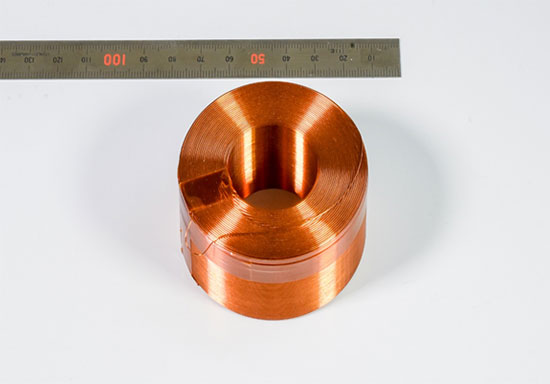
Generally speaking, bobbin type coils are cheap and air core (bobbin-less) coils are
expensive, common sense dictates that if some multiple of bobbin type coils, say 12 or
24, works out to just one air core type coil, the air core type is not going to
compete.
However, if you take into account the costs of the bobbins, their molding costs and the
machinery or machinery modification costs, in this era of rapid change, particularly in
edge cases dealing with quantities of around 100,000 - 300,000 pieces a month, depending
on the methods used there are cases where air core coils are far cheaper.
The challenge is to develop air core coils that can compete on price with bobbin type
coils even for production runs of one million.
> In an industry-first, Selco has succeeded in fully automating air core coil
production.
Preconception 8:Overmolding coils can get expensive.
Usually this is correct in general terms.
But what about if it was possible to mold a coil with another functional component (a
connector part, etc.) simultaneously?
Coil overmolding can produce benefits when used as a combination technique.
It is thought that the resin molding method of combining a case with an air core coil
can be an innovative technology for solenoid coils.
Preconception 9:Square pins are best as binding pins for coils!
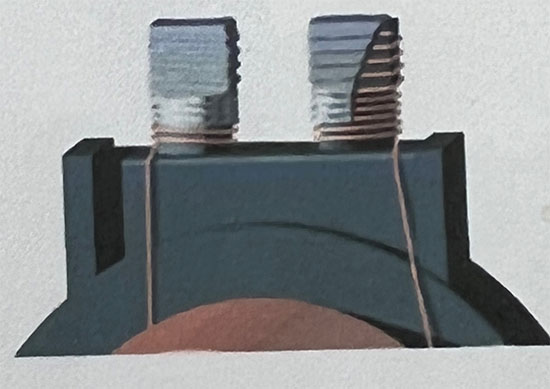
Many people may be surprised to learn that square pins are actually "breakage inducing
pins." Square pins are actually the worst option for coils.
This is because when copper wire is attached to a square pin, the coating of the copper
wire is already broken, and if the square pin is bad, it can damage the wire to near
breaking point.
If it is about to break, it can still be rescued by covering it with solder, but if it
is overmolded with resin, it will inevitably end up as a semi-broken reserve.
Selco has already overcome this problem.
We did this with Kakumaru-kun, a round terminal that takes the best from both worlds -
the workability of square terminals with the safety of round terminals.
(See the Kakumaru-kun pamphlet)
Preconception 10:A coil shop cannot wind a coil unless the specifications are decided.
Admittedly, this was also the case at Selco until recently.
"Please provide us with the diameter, number of loops and resistance value."
Recently, however, our approach has changed to "please let us know the properties and
dimensions you require, along with a preferred diameter." Various customers consult with
us when they are at the stage of determining specifications. We use the technologies,
expertise and ideas we have cultivated over the years to propose optimal specifications
to the customer, and benefits to cost and quality are derived as a result.
Recently, we have been moving in a slightly different direction from existing coil
shops, although still remaining related to coils, by getting more involved with design,
study, and even consulting work, and this is an area I would hope could be an income
stream in itself.
We at Selco are truly a "coil and coil-related technology solution company."
Preconception 11:The limits for the aligned winding are at least 50μ for fine wire, and up to around 10 layers at 200μ for thick wire.
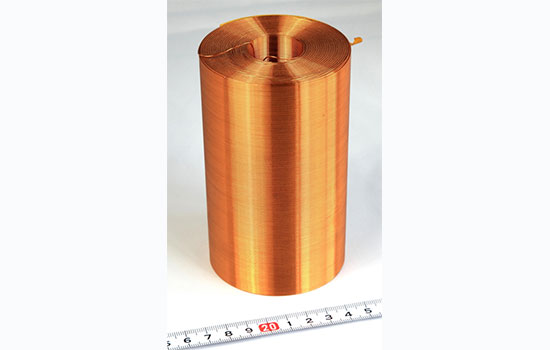
Conventional thinking suggests that up to around 50μ is the limit for multi-layer
alignment winding for fine wire, and about 10 layers at the 200μ class for thick wire.
At Selco, however, we have successfully produced perfectly aligned fine wire at 20μ ×
400T, full air core coils at 220μ × 10,000T (over 20 layers), and perfectly aligned
bobbin winding coils at 600μ × 20,000T (about 40 layers).
These are outstanding achievements that are a product of our focus on perfectly aligned
winding.
Preconception 12:Overmolding of fine wire coils runs the risk of wire breakage.

In the case of regular coils, even for thick wire if the product is haphazardly
overmolded or integrally molded, the coil can be extremely dangerous when exposed to
high voltages or high heat.
A fine wire of 70μ or less is even more dangerous.
Around the world, companies are carelessly overmolding in ignorance of this hazard, and
it is actually quite dangerous.
I consider this technique to be far more dangerous and difficult than the bending,
compression and shaping technologies that Selco maintains.
Selco has built up expertise through the mass production of swinging arms for hard disk
drives and coil molded products for optical pickups.
In today's world, where everything is getting progressively smaller and denser, there
are ever-increasing demands for safety-focused precision and miniaturization.
We believe that as coils become increasingly dense, there is a greater need for
technologies to integrally mold coils with other components.
Preconception 13:Together with the coating, around 75% is a good fill factor for regular alignment winding of round wire.

Usually, the fill factor for alignment winding of round wire is 73-77%, but our coils
raise that by 10% to 83-87%.
With our patented technology, we have achieved a fill factor of greater than 96%.
The fill factor when coating is excluded is around 10% lower, at a little over 80%.
For the hybrid and electric vehicles of the future, the battle will truly be about fill
factor, and depending on the winding method, a much higher fill factor than flat wire
can be ensured.
Preconception 14:Solenoid coils are bobbin-wound.
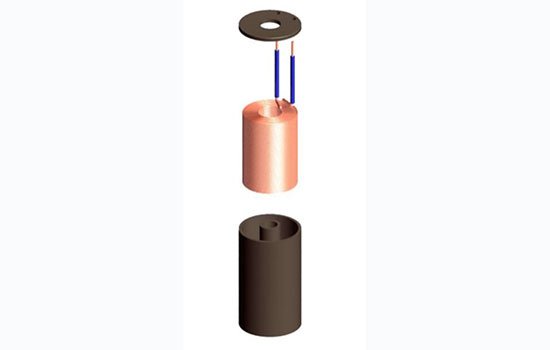
Selco has a new technology for solenoid coils: the high-performance encapsulated
coil.
This technology exchanges the bobbin-wound coil for an air core coil and uses a coil
case instead of a bobbin and taping. The resultant difference in resin wall thickness is
up to 30% and space is increased by around 10% thanks to the higher coil density. One
solenoid manufacturer that prototyped the technology reported a 50% improvement in
magnetomotive force.
Preconception 15: Using flat wire increases the fill factor.
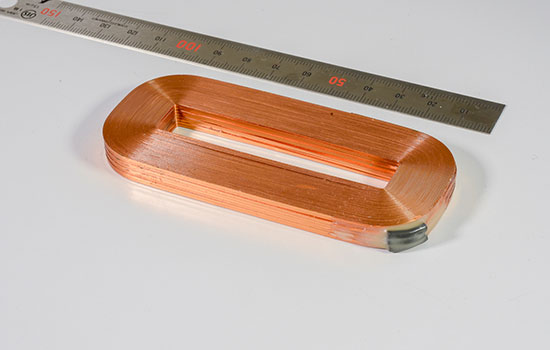
The idea that using a flat wire increases fill factor is a common misconception.
While a flat alpha winding coil without doubt provides the highest fill factor, the
multilayered winding of flat wire ultimately leads to disordered cross points (the parts
stuck on top), and for this part, flat wire has a far inferior fill factor to round
wire.
In addition, when using flat wire, there can be difficulties coating each of the four
corners, making it necessary to make the coating quite thick.
Since round wire has no such concerns in that regard, the desired coating thickness can
be achieved.
It is possible to make the coating thick if the focus is on safety, and thin if the
priority is physical properties, and with round wire, the coating is quite resistant to
damage when compressed or bent.
Selco has also achieved the highest grade of flat alpha layered winding coil by joining
multiple flat alpha winding coils.
This enables multi-layer winding in multiples of two.
Preconception 16:A motor core (teeth) cannot be wound at high density.
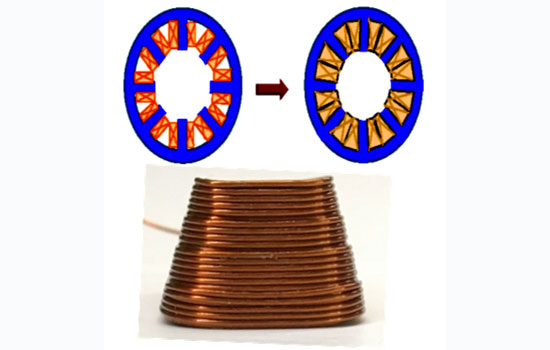
This is another commonly held belief that Selco has expertly debunked.
Flat alpha winding coils use various techniques including "stepping," "curves,"
"lamination" and "high density" to produce things that almost look like works of
art.
To differentiate our products from competitors, we need to design motors that use high
fill factor coils such as these.
(See ultimate coil for rotating equipment)
Note that when this coil is used, it is not possible to use a shape with a bulge at the
top of the teeth.
The tip of the core needs to be made straight, or a split core needs to be selected.
Preconception 17:No matter how well coils are arranged, there is no way they can be used in high-efficiency generators.
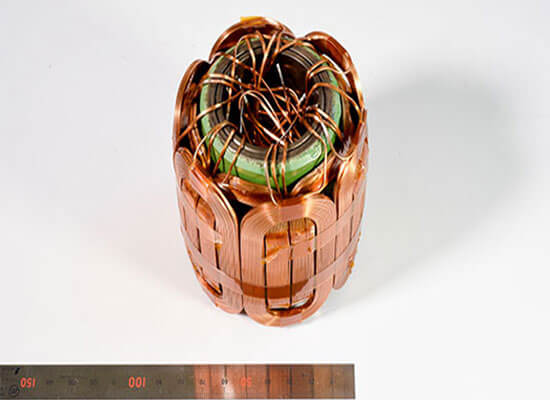
This is something I was told by someone who previously worked at a motor manufacturer.
Much to their surprise, however, we ended up completing a compact generator that output
high efficiency data.
(The generator produced a maximum generating efficiency of 85%, higher than the existing
65%)
As an added bonus, the generator also had no cogging torque.
This was because we came up with the idea of using our specialty of curving and
deforming flat alpha-winding coils and devising a motor shape that fills the core with
hardly any gaps.
Recently, manufacturers employing coreless motors that use this assembly structure have
appeared, and it appears they are producing high-performance motors and generators as a
result.
Preconception 18: Coils will never be able to compete with China or Thailand in terms of price.
Dispelling this conventional wisdom was one of our greatest challenges.
There is only one way to beat cheap labor -- eliminating human labor through full
automation.
But the large investments major manufacturers are making in robots and automation can
spell an immediate bad investment for medium, small and micro-sized companies such as
ourselves.
We overcame this barrier by developing robots and automation through proprietary
hardware and software.
First, we managed to automate the processes of winding, forming, cutting, soldering and
packing for air core coils, our specialty.
This made it possible to effectively compete with overseas producers in terms of cost,
as long as large quantity production continues for some time, especially for air core
coils.
Of course, this is also possible for bobbin type coils and series-wound coils, and as
long as you pay, existing winding machine manufacturers can easily accommodate you, so
for the meantime we are competing on the basis of fully automated equipment for air core
type coils, which is not available anywhere else.
Preconception 19: Manufacturing should take place in Japan!

This is something I have always advocated, but currently the bulk of our production is
in Thailand, followed by Dalian.
The reason for this can be summed up by the idea "producing Made in Japan overseas."
If we can produce at or above the level of Japanese manufacturing, this poses no problem
whatsoever.
Twenty-five years ago, T.I.T. ELECTRONICS established itself in Thailand.
The company's president at the time (now its Chairman) gave up his position as the
president of Selco and began coil production in Thailand during an era when chaos still
reigned.
It's a long story, suffice to say that my brother developed a plant that worked as
designed in Thailand.
In other words, he developed what he thought was the ideal production lines, and created
the high-efficiency, high-quality plant he had envisioned.
Unlike usual overseas plants, this plant has an excellent retention rate with its
workers on par with that of Japanese workers. Moreover, as well as having highly skilled
workers, the quality control system functions almost perfectly.
At this company of 300 employees, there are only two Japanese managers for three plants.
Even the main plant has only one person, and this poses no problems whatsoever for
regular operations.
The company maintains a number of very expensive image measurement units from Keyence
that not only perform defect analysis but are also used for mass production, much to the
surprise of the Keyence represenatives.
At the Dalian Plant, there is not a single Japanese employee.
But this plant works on coils that involve levels of difficulty that are high even by
Japanese standards, and they are doing their best to endure unreasonable demands from
Japan.
The team currently consists of 25 people, and they are a group of people who can work on
elaborate and troublesome coils to a high level of quality.
The Dalian Plant came about from a trainee who worked for three years in Japan. He was
one of the 18 trainees who visited, and a key point to the success of the plant was that
we appointed this most talented and honest person in charge of quality and
technology.
After that, it is crucial to never let them lose focus.
Now since we have useful communication tools such as LINE and WeChat, I never fail to
check up on the situation by contacting the manager in Dalian on a daily basis to talk
about quality issues and the Japanese approach to managing employees.
Since I am the general manager of the company, I make trips to Dalian every few months,
and at those times the reverse happens where the issues in Japan are pointed out.
Under this structure, our main production sites are in Thailand and Dalian, where we
practice "Made in Japan" manufacturing.
Preconception 20: Compression mold coils to increase their fill factor!?

Fill factor (1)
Producing a fill factor greater than flat wire with round wire!?
I think most people think that fill factor means flat wire or square wire.
But Selco has a technology that enable round wire to surpass flat wire.
That technology is high-density compression molded coils.
This is a technique of precisely winding the round wire and compression molding it into
the required shape.
Fill factor (2)
Compressing and molding wire damages the coating!?
That's right.
Simply compressing the coil can be extremely dangerous.
Selco already owns patents for high-density coils, and we have been conducting extensive
research into ways to compress coils without damaging the wire.
However, since there is also the question of the degree to which a coil should be
compressed and this varies depending on the specifications of the product, please feel
free to consult with us.
Fill factor (3)
How do you put a coil that has been compressed and molded with concentrated winding into
a motor core!?
As this technology involves inserting the coils afterwards, it cannot be used with cores
whose teeth are not straight.
Unfortunately, it cannot be used with regular motor cores (which have D-shaped
protrusions on the tips of the teeth).
However, with split core technology, this technique can be used.
At the moment, we recommend its use for SR motors which use straight cores.
Fill factor (4)
The ultimate fill factor of 100% is impossible!?
It is possible.
It can be achieved using flat alpha layering and curving technologies.
Please take a look at the page on "the ultimate coils for rotating equipment" under the
Coil Concept section.
By processing flat wire to match the core teeth, a fill factor that could be described
as 100% (coating included) can be achieved.
The above are just a few typical examples.
Above all, our greatest strengths at Selco are the ability to develop proposals and our
technological capabilities.
We want to move beyond the conventional wisdom surrounding coils and provide customers
with the know-how to offer the highest quality at the lowest prices.
For those of you reading this website who are looking for the most efficient coil
specifications or dealing with issues and doubts regarding your current coils, if you
throw the problem our way, we would be delighted to take responsibility for providing
you with the most suitable proposal.
Depending on your requirements, it may take time to meet your needs, but as we will
always get back to you in some form within 24 hours of an inquiry, please feel free to
contact us for a consultation.